
Nephron Diagram: Labeled Filtration Pathway
A nephron diagram is a labeled illustration of the kidney's basic functional unit, tracing the path filtrate takes as it is filtered from blood, adjusted in composition, and ultimately concentrated into urine. Unlike a diagram of the whole kidney, a nephron diagram zooms in on a single microscopic tubule — one of roughly a million repeated in each kidney — and follows it in order from where filtration begins to where the final urine exits. Reading it correctly depends on treating it as a sequential process diagram rather than a static anatomical map, since the composition of the fluid changes at every labeled segment.
What a Nephron Diagram Shows
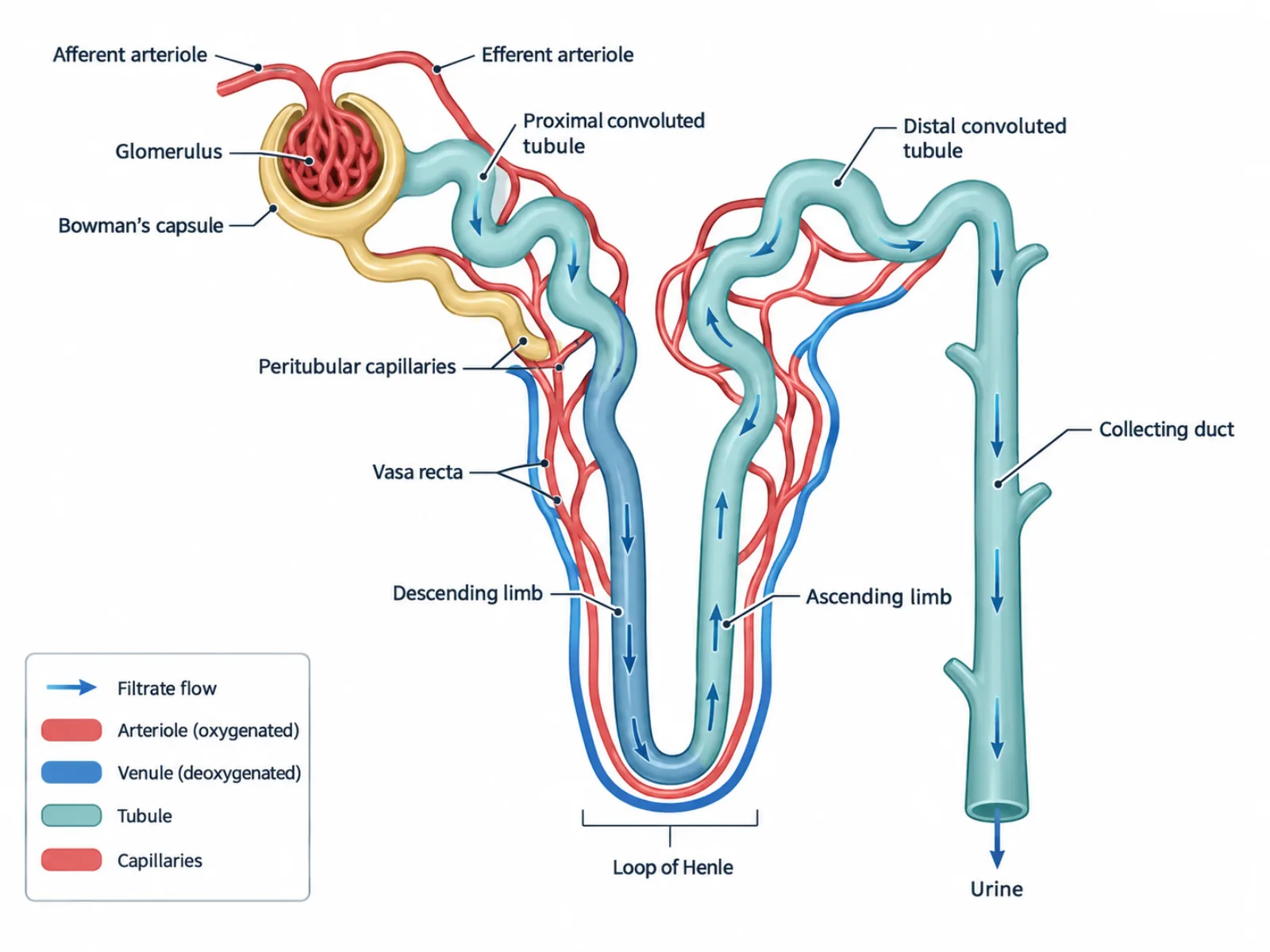
The diagram represents the kidney's smallest functional unit responsible for producing urine, and it condenses three distinct physiological processes into one continuous structure: filtration, reabsorption, and secretion. Blood enters the nephron under pressure, some of its fluid is filtered out, and that filtrate then travels through a long, looping tube where useful substances are pulled back into the blood and waste products are added in. A nephron diagram is drawn as a single unbroken tubule with an arrow indicating the direction of filtrate flow, because the order in which the fluid passes through each segment determines what happens to it chemically.
The Labeled Parts of a Nephron Diagram
- Glomerulus — a knot of capillaries where blood pressure forces water and small solutes out of the blood, initiating filtration.
- Bowman's capsule — a cup-shaped structure surrounding the glomerulus that collects the filtered fluid.
- Proximal convoluted tubule (PCT) — reabsorbs most of the glucose, amino acids, ions, and water from the filtrate back into the blood.
- Loop of Henle, descending limb — permeable to water, allowing the filtrate to become progressively more concentrated as it descends into the salty medulla.
- Loop of Henle, ascending limb — impermeable to water but actively pumps salts out of the filtrate, diluting it as it rises back toward the cortex.
- Distal convoluted tubule (DCT) — fine-tunes reabsorption and secretion under hormonal control, adjusting the filtrate's final composition.
- Collecting duct — performs the last adjustable stage of water reabsorption, regulated by antidiuretic hormone (ADH).
- Peritubular capillaries and vasa recta — blood vessels running alongside the tubule that pick up the substances reabsorbed at each stage.
How to Interpret the Diagram: Reading the Filtration Pathway in Order
A nephron diagram should be read start to finish, following the single arrow that traces filtrate through the tubule. Begin at the glomerulus and Bowman's capsule, where filtration occurs; then follow the fluid into the proximal convoluted tubule, where the bulk of reabsorption happens; then down the descending limb of the loop of Henle, where water leaves the filtrate; then up the ascending limb, where salts leave instead; then through the distal convoluted tubule, where hormonally controlled fine adjustments occur; and finally into the collecting duct, where ADH determines how much additional water is reabsorbed before the remaining fluid becomes urine. The peritubular capillaries and vasa recta are drawn running parallel to the tubule rather than as a separate structure, because their entire function is to receive whatever the tubule reabsorbs at each point along its length — reading them alongside the tubule segment they wrap around, rather than in isolation, is key to understanding the diagram. It also helps to notice which segments are drawn in the diagram's cortex region versus its medulla region, since that placement is not decorative but reflects real kidney anatomy.
Common Mistakes When Reading or Drawing a Nephron Diagram
The most common mistake is conflating filtration, reabsorption, and secretion as if they were interchangeable terms for "moving substances." In fact, filtration is restricted to the glomerulus alone, reabsorption occurs continuously along the whole length of the tubule, and secretion is concentrated mainly at the distal convoluted tubule — treating these as one blended process obscures what each labeled segment actually does. A second common error is reversing which limb of the loop of Henle is water-permeable: the descending limb allows water to leave the filtrate, while the ascending limb blocks water movement but pumps out salt instead, and swapping these two reverses the entire concentrating mechanism the loop is built to achieve. A third mistake is forgetting the diagram's spatial layout matters: the glomerulus, proximal convoluted tubule, and distal convoluted tubule all sit within the kidney's cortex, while only the loop of Henle and collecting duct dip down into the medulla — a diagram that draws the whole nephron in one uniform region loses this cortex-medulla distinction, which is central to how the kidney concentrates urine.
Nephron Diagram vs. Whole-Organ Diagrams
A nephron diagram operates at a fundamentally different scale than a whole-organ diagram such as a heart diagram. A heart diagram depicts the gross anatomy of a single, large, visible organ, showing chambers and vessels that are all part of one unified structure functioning as a pump. A nephron diagram, by contrast, shows one repeating microscopic unit, of which each kidney contains roughly a million copies working in parallel; drawing "the nephron" is really drawing a representative example, not a one-of-a-kind structure. This distinction affects how each diagram is read: a heart diagram is interpreted as a map of one organ's internal anatomy, while a nephron diagram is interpreted as a process pathway for a single functional unit — understanding one nephron tells you how the entire kidney filters blood, in the same way understanding one assembly line station tells you how the whole factory processes its product.