

Choose a homonuclear diatomic molecule or ion and this molecular orbital diagram generator draws the atomic orbitals, the bonding and antibonding molecular orbitals between them, and fills every electron in the correct energy order, so bond order and magnetism come out right every time.
Bond order: 3
Diamagnetic - all electrons are paired
A molecular orbital diagram generator earns its keep on the cases where a simple dot-and-line structure runs out of answers. These four, drawn with the same tool as above, are the ones general chemistry courses come back to again and again.
N2 fills its bonding orbitals - sigma2s, both pi2p orbitals, and sigma2p - completely, with none of the higher antibonding orbitals touched. That gives a bond order of exactly 3, matching the triple bond chemists have always drawn for nitrogen, and every electron ends up paired, so N2 is diamagnetic.
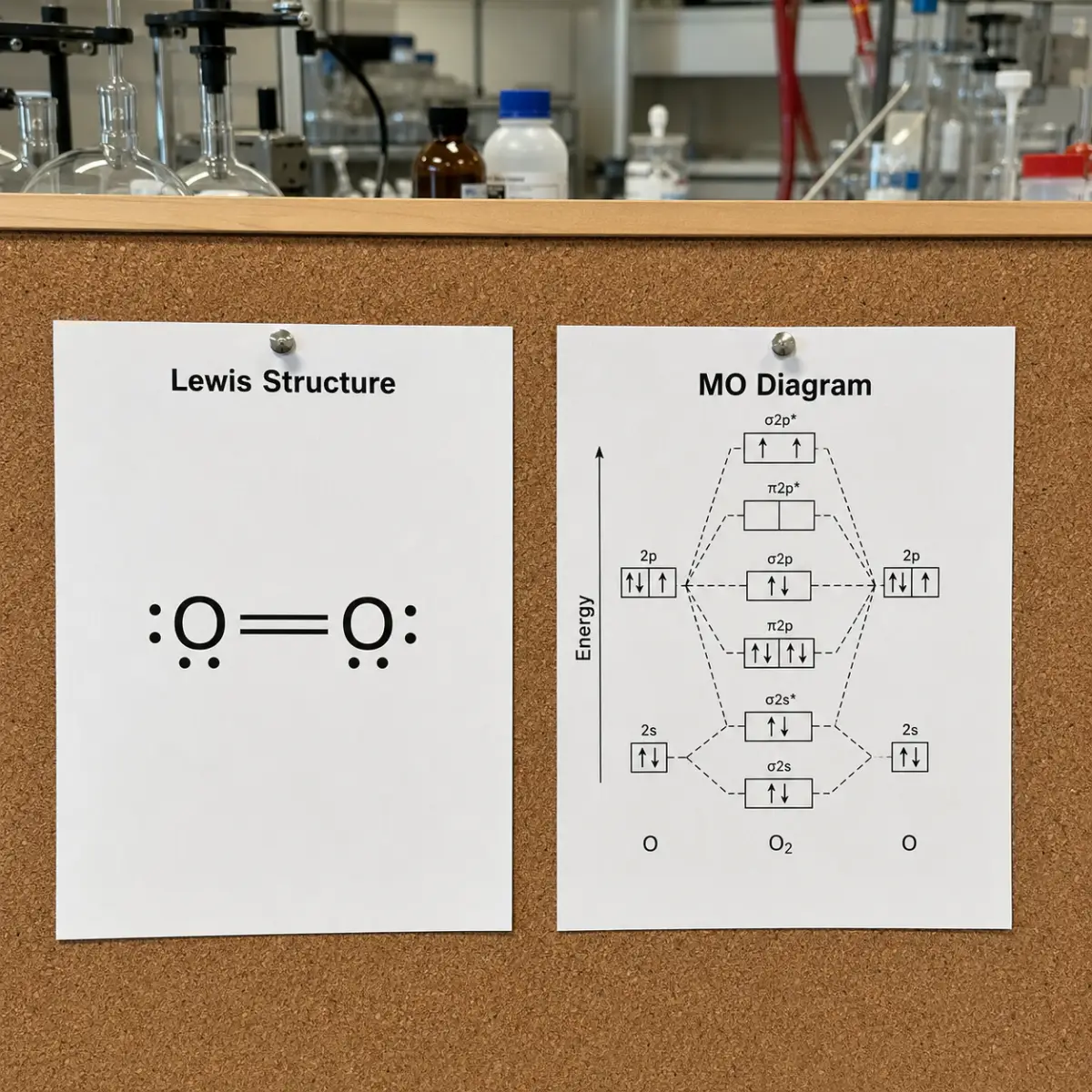
Draw O2 with a Lewis structure and every electron looks paired, but liquid oxygen is visibly drawn to a magnet. This diagram shows why: the last two electrons split across the degenerate pi*2p orbitals with parallel spins by Hund's rule, leaving two unpaired electrons and a paramagnetic molecule with bond order 2.
Combine two helium atoms and every electron that fills the bonding sigma1s orbital is matched by one filling the antibonding sigma1s* orbital. The bond order calculator built into this generator returns exactly zero, which is the formal way of saying there is no net bond holding the two atoms together.
Add electrons to O2 one at a time and each lands in an antibonding pi*2p orbital. The bond order calculator tracks the cost directly: O2 sits at bond order 2, superoxide O2- drops to 1.5, and peroxide O2(2-) falls to 1 once both pi* orbitals are full. The oxygen-oxygen bond gets measurably weaker and longer at each step.
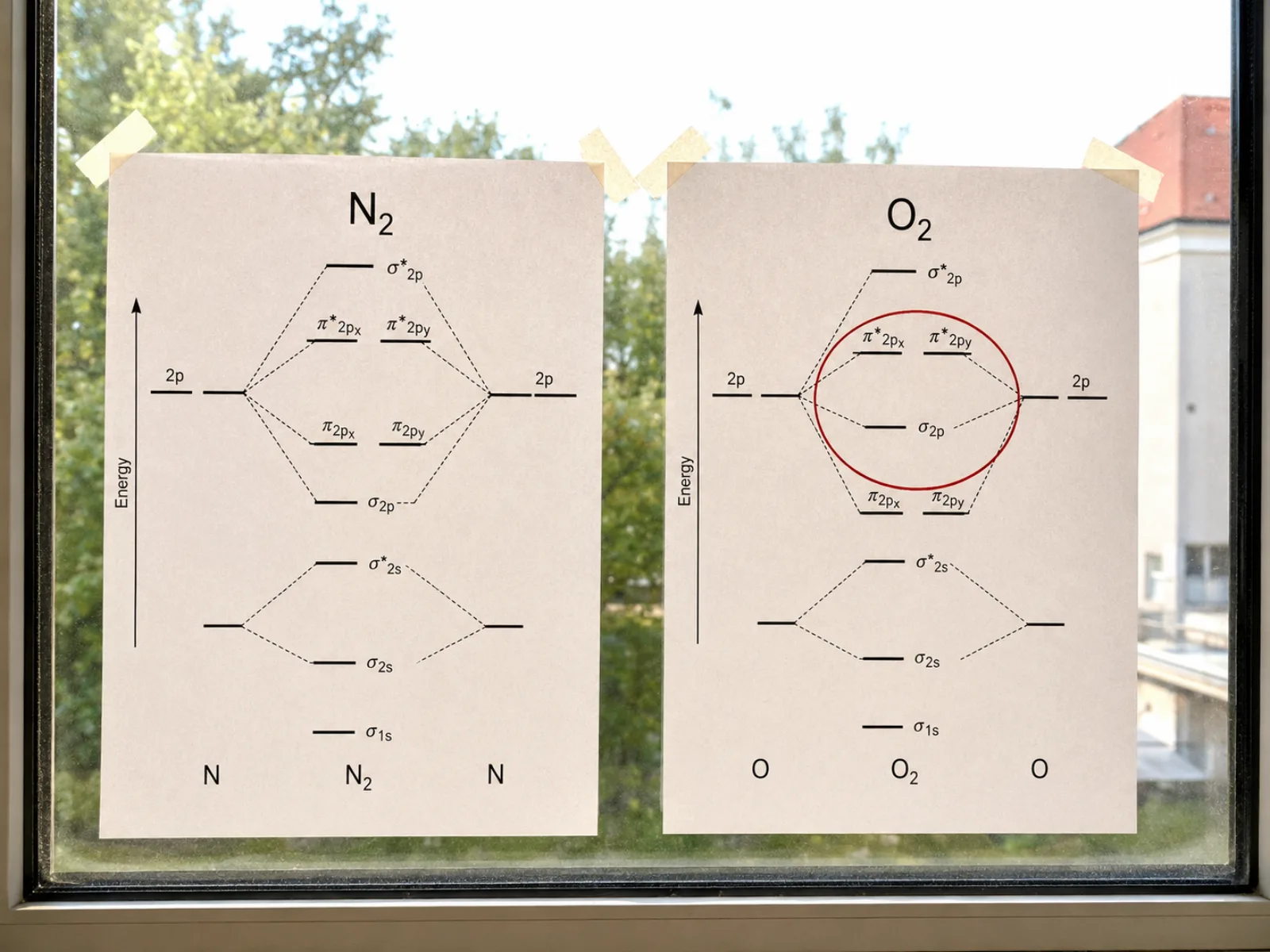
For Li2 through N2, s-p mixing pushes sigma2p above pi2p; for O2 and F2 that mixing weakens and sigma2p drops back below pi2p. This generator switches orbital order at the right point instead of applying one fixed sequence to every period-two molecule - exactly where a naive diagram gets B2 and O2 wrong.
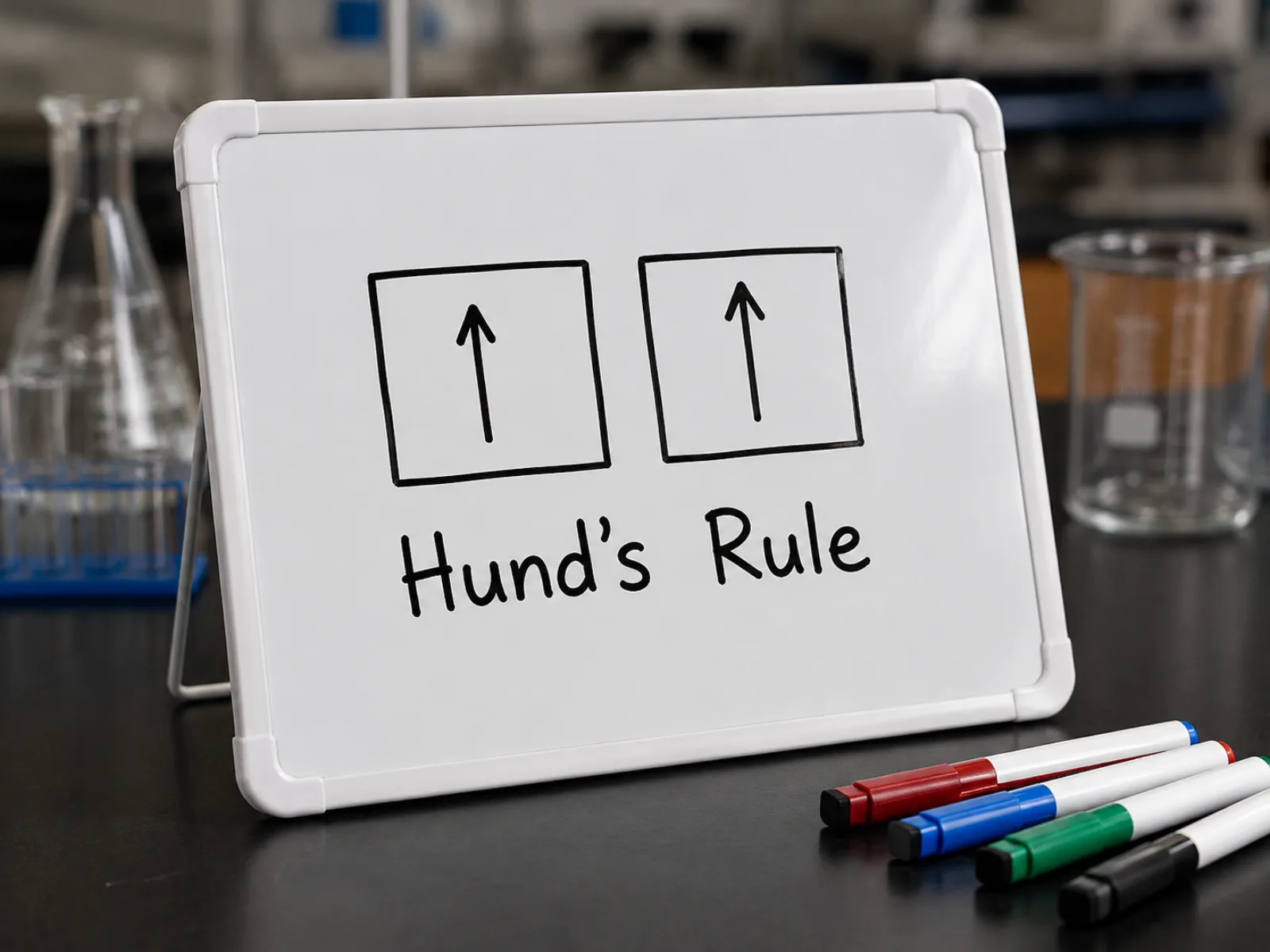
Whenever electrons reach a doubly degenerate pi2p or pi*2p pair, this molecular orbital diagram generator fills one electron into each orbital with parallel spin before letting any orbital take a second, paired electron - the same rule applied to p orbitals in an atom, carried over correctly to molecular orbitals.
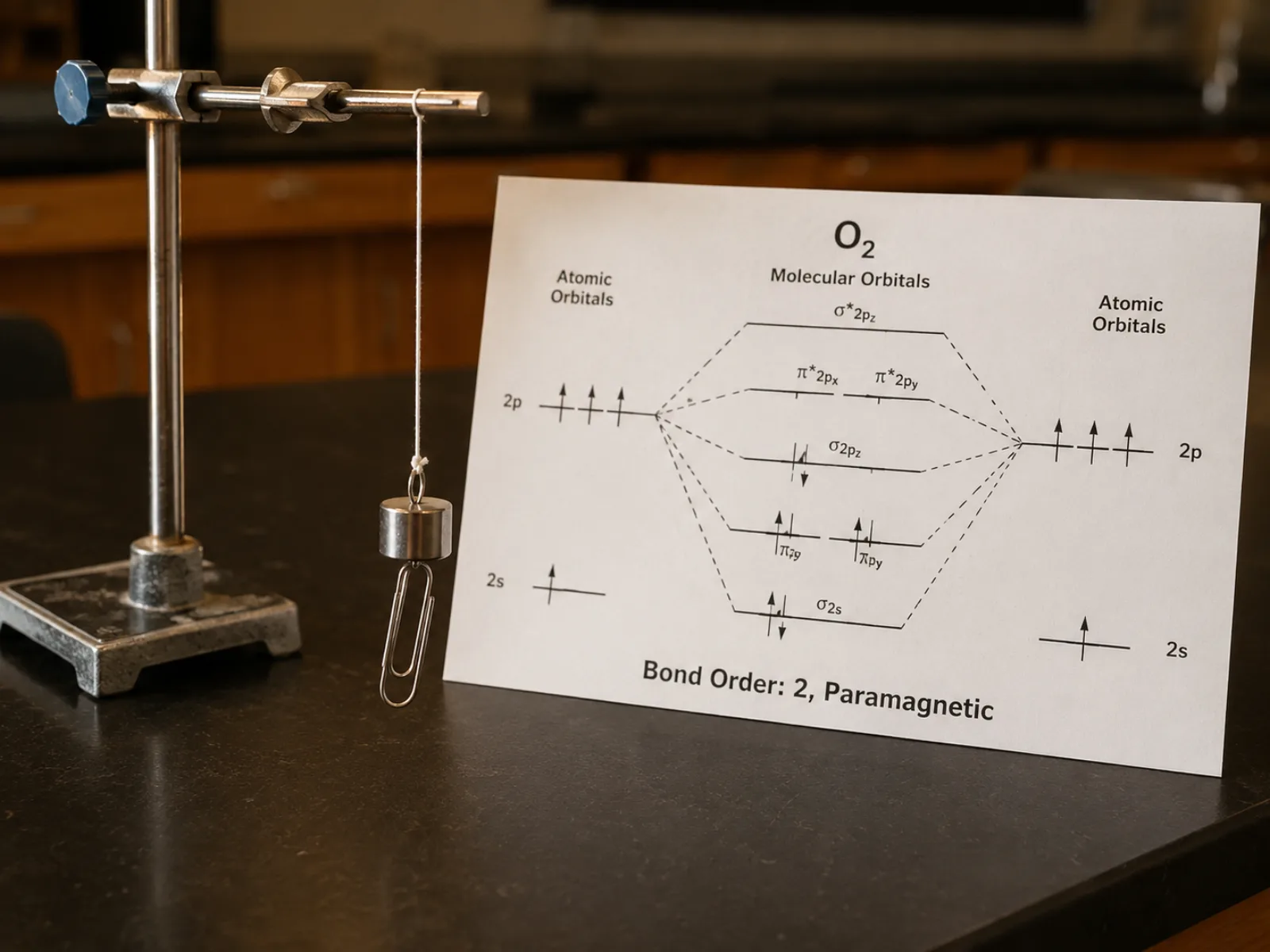
The bond order calculator built into every diagram reads the final electron count in bonding and antibonding orbitals and reports both the numeric bond order and whether the molecule is paramagnetic or diamagnetic, so there's no counting electrons by hand.
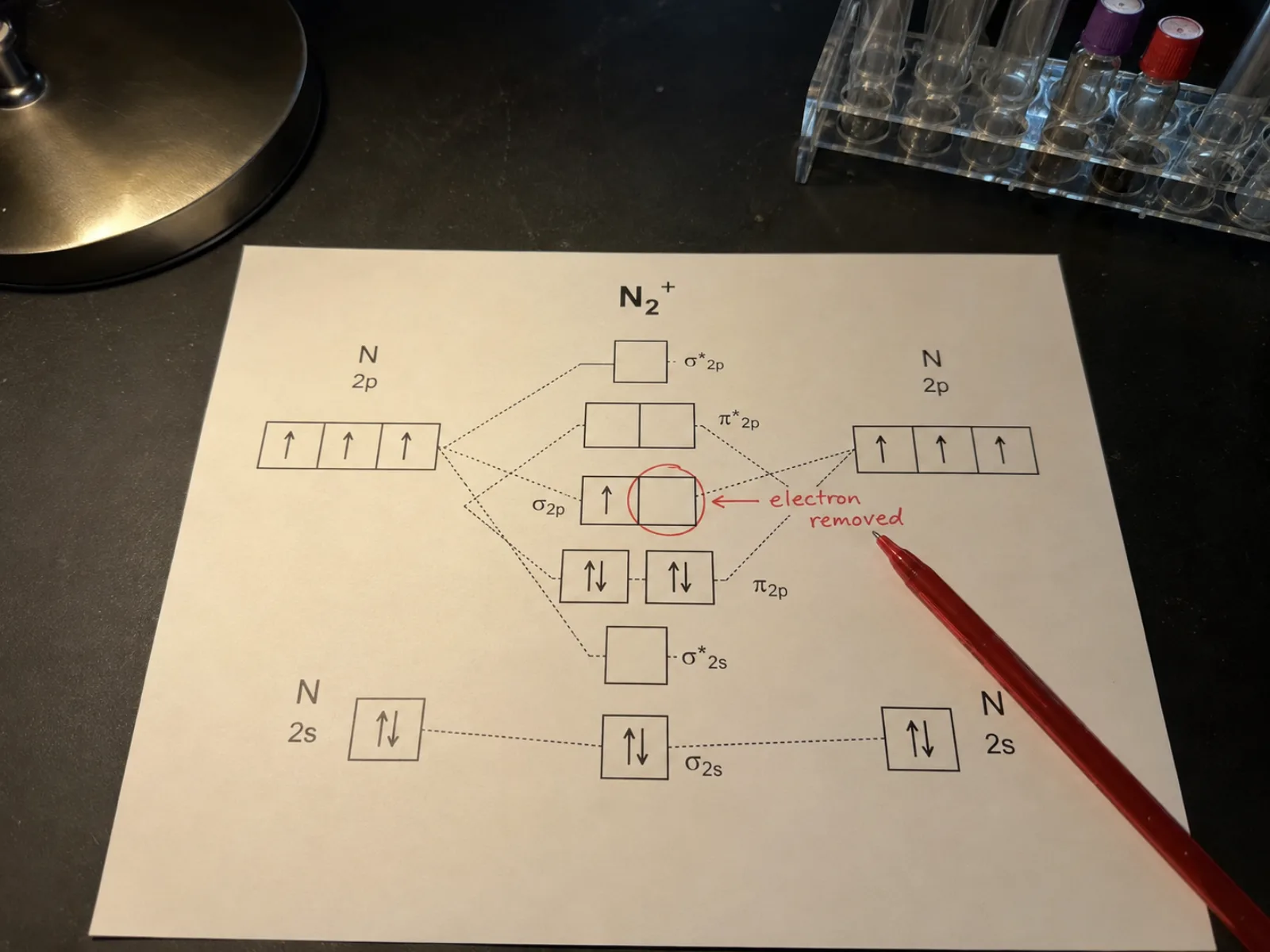
Removing or adding an electron changes which orbital gets touched last, and that single electron can shift bond order by a full half-integer step. This tool covers N2+, O2-, and O2(2-) alongside the neutral molecules so ionization questions have a diagram to point to.
A Lewis structure tells you how many bonds connect two atoms and where the lone pairs sit, but it treats every bonding pair the same way and says nothing about how strongly a bond actually holds. Molecular orbital theory instead combines atomic orbitals from both atoms into a new set of molecular orbitals - some lower in energy (bonding), some higher (antibonding) - and fills them the way electrons fill atomic orbitals: lowest energy first, one electron per orbital before pairing.
That extra structure produces two numbers a dot structure can't: bond order, calculated as (bonding electrons minus antibonding electrons) divided by two, quantifying bond strength beyond whole numbers, and magnetism, which follows from whether any orbital ends up with an unpaired electron. Oxygen is the textbook case - its Lewis structure looks perfectly paired, but the molecular orbital energy diagram shows two electrons forced into separate, equal-energy antibonding orbitals, and that mismatch is why liquid oxygen clings to a magnet.
The tradeoff is scope: this generator is built for homonuclear diatomics, where both atoms contribute identical atomic orbitals at matching energies. Heteronuclear molecules mix atomic orbitals of different energies and weight each atom's contribution differently, and anything beyond a diatomic needs a full symmetry treatment. Reach for a Lewis structure when you need geometry and formal charge, and reach for an MO diagram when the question is really about bond order or magnetism.
Every diagram below comes from the same deterministic rules this tool uses on-screen, so the preview and the download always agree.
Choose from a checked list of homonuclear diatomics: H2 and He2 from period one, Li2 through F2 from period two, and common ions like N2+, O2-, and O2(2-).
This MO diagram maker places every electron in energy order, applying the Pauli exclusion principle and Hund's rule automatically - degenerate pi orbitals get one electron each before any pairing starts.
The bond order calculator reports (bonding electrons - antibonding electrons) / 2 next to the diagram, along with whether unpaired electrons make the molecule paramagnetic or whether every electron is paired for a diamagnetic result.
Export a vector file for a lab report or slide deck, or a PNG for quick sharing. Both match exactly what was drawn on screen.
Both models describe the same molecule but answer different questions. Use this table to decide which one to reach for.
Electrons belong to the whole molecule
Electrons belong to specific atoms or bonds
Questions we hear most from general and inorganic chemistry students working through bonding units.
More classroom-ready generators to pair with this tool for a full bonding and structure unit.
The molecule picker is right at the top of this page - switch species, compare bond orders, and pull a fresh SVG or PNG from this molecular orbital diagram generator whenever the next question comes up.