

Type an element symbol or atomic number and this Bohr diagram maker plots the nucleus and every electron shell using each element's real ground-state configuration, not a one-size-fits-all rule.
A Bohr model maker is only useful if it gets the shell counts right for more than the first row of the periodic table. These four cases, drawn with the same Bohr diagram maker as the tool above, show why the rule can't stay 2-8-8 forever.
The simplest atomic model there is: a single proton at the center and one electron in the K shell. It's the diagram most students draw first, and the baseline every other element builds on.
Six protons, six neutrons, and electrons split 2 in the K shell and 4 in the L shell. Four outer electrons is exactly why carbon forms four bonds and anchors organic chemistry.
Set the charge to +1 and sodium's lone M-shell electron disappears, leaving a Na+ ion with the same electron count and shell pattern as neon. This is the octet rule made visible.
Chromium's real configuration is 2, 8, 13, 1, not 2, 8, 14, 0. One electron jumps ahead into the N shell before the M shell fills, a well-documented exception this Bohr model maker plots correctly instead of hiding it.
Every diagram below is generated from the same deterministic rules this Bohr model maker uses on-screen, so what you see in the preview is exactly what downloads.
Type a chemical symbol like Fe or an atomic number like 26. This Bohr model generator looks up that element's real electron shell configuration instead of applying a fixed formula.
Leave the charge at zero for a neutral atom, or enter a value from -3 to +3 to see electrons added to or removed from the outermost shell as a cation or anion.
Turn on element name and symbol, K/L/M/N shell letters, and the outer-shell electron count depending on what the worksheet or slide needs this Bohr diagram maker to show.
Export a crisp vector file for print handouts or a PNG for slides and documents. Both come straight from the same on-screen diagram this Bohr model maker drew, so there's nothing to re-check for accuracy.
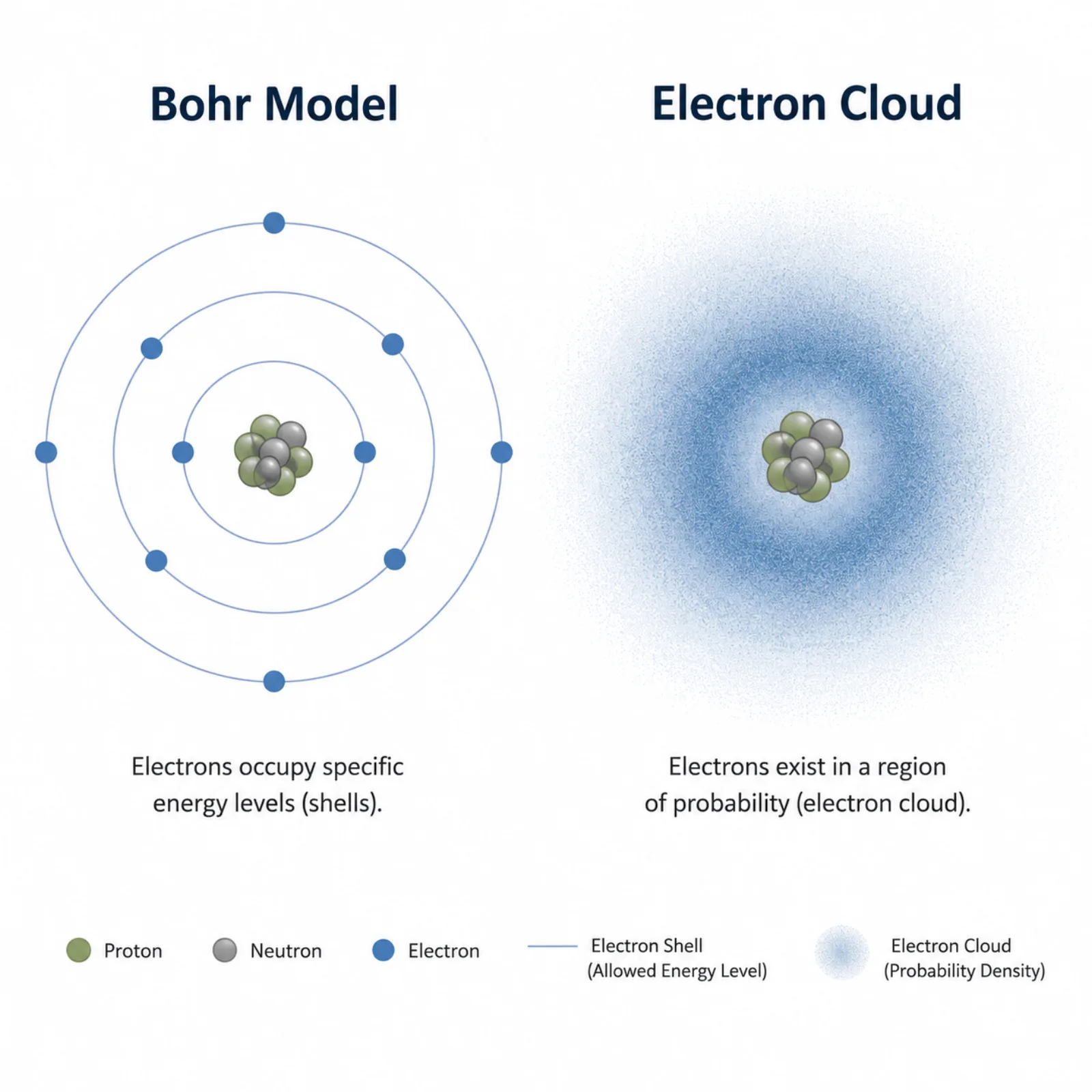
A Bohr model represents an atom as a dense nucleus surrounded by electrons traveling in fixed, circular shells, each holding a set maximum number of electrons. Niels Bohr proposed it in 1913 to explain why hydrogen's atomic spectrum showed sharp lines instead of a smooth band, and it remains the standard first atomic model taught in introductory chemistry because it makes electron shells and valence electrons visible at a glance.
It is also a known simplification. Electrons don't orbit like planets on flat rings; quantum mechanics describes their positions as probability clouds with distinct shapes, and a single shell like the third one actually contains three sublevels (3s, 3p, 3d) that fill in an order the shell-only picture can't show. That's exactly why chromium and copper look like exceptions in a Bohr diagram: the model is reporting a real 4s-before-3d filling order without having the sublevel detail a full quantum atomic model would show.
Treat the Bohr model as a teaching diagram for counting valence electrons, reasoning about ionic charge, and seeing periodic trends, not as a claim about where an electron physically sits at any instant, and not as a complete atomic model on its own. For anything past the fourth period, or for questions about bonding geometry and magnetism, a quantum-mechanical orbital model is the correct next step.
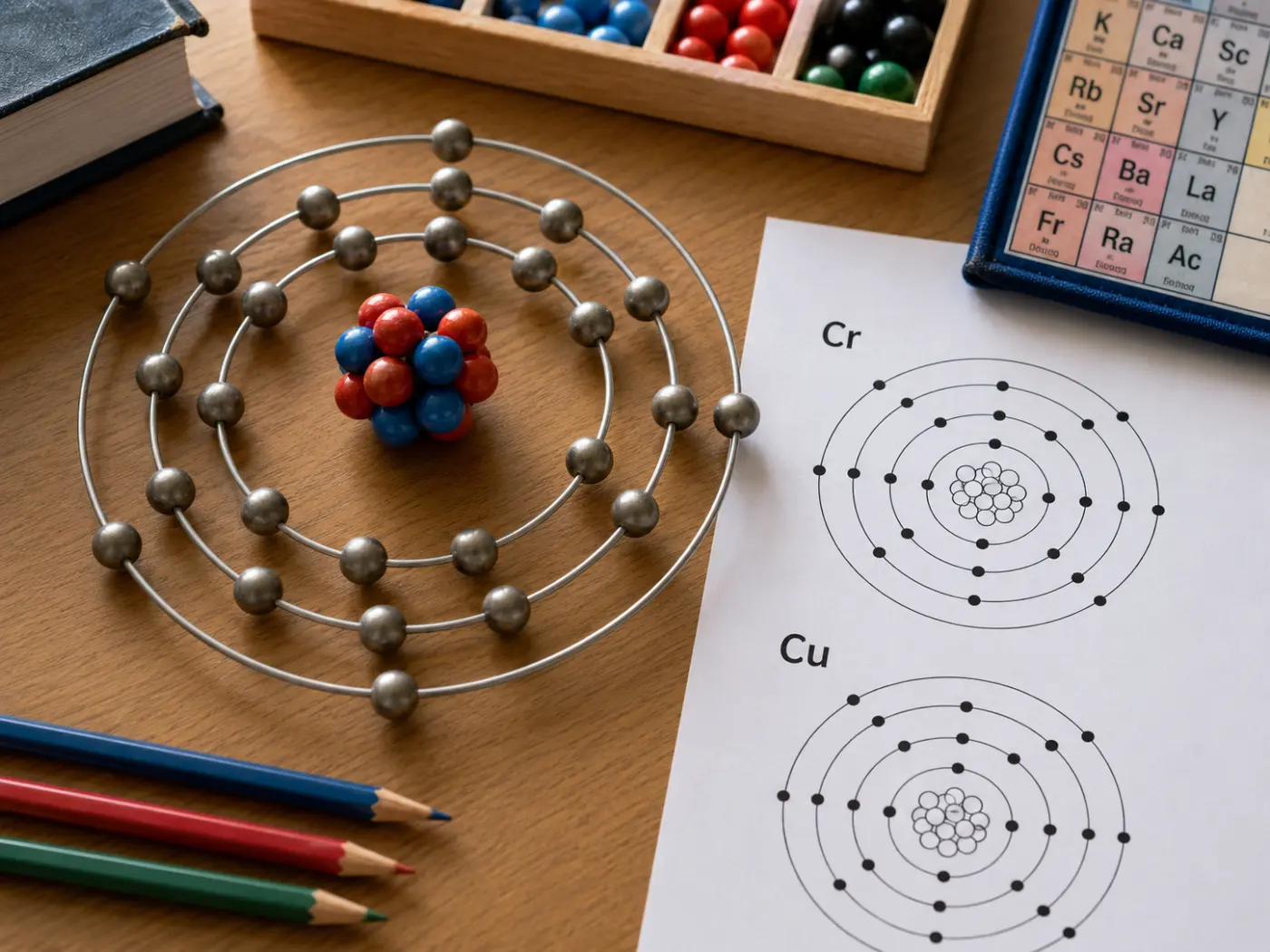
Every element from hydrogen to krypton uses its documented ground-state shell configuration. Chromium and copper keep their actual 4s-3d crossover instead of being forced into a generic 2-8-8-18 pattern that would just be wrong for those two elements in any atomic model.
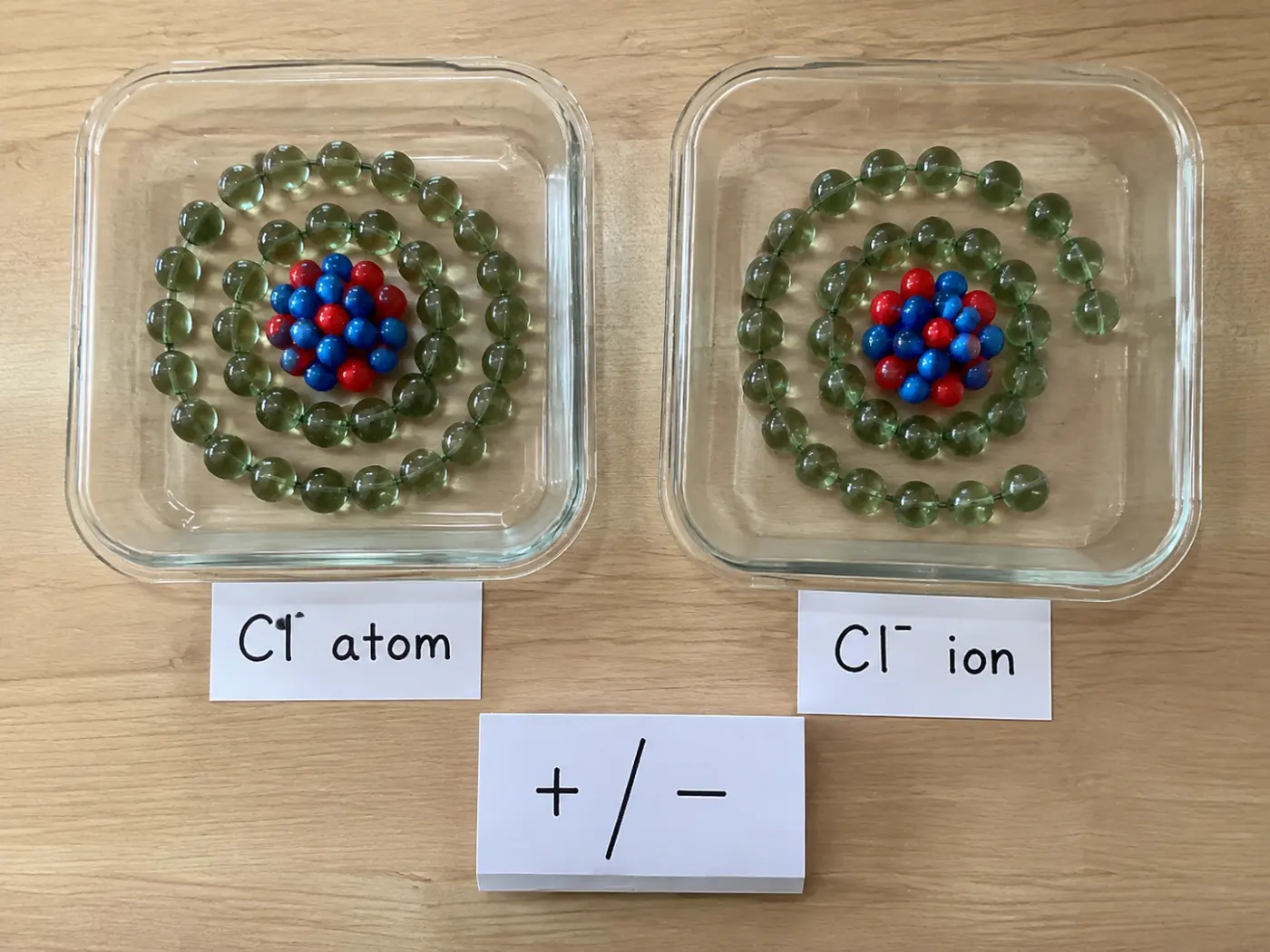
Set a charge from -3 to +3 on a main-group element and this Bohr diagram maker redistributes electrons the way ionization actually works: cations lose electrons from the outermost shell inward, anions gain them up to that shell's capacity, so a chlorine atom and a Cl- ion look correctly different.

Export a vector SVG that stays sharp at any size for handouts, or a PNG sized for slides. The file always matches what's on screen, so this Bohr model generator never hands you an export that drifts from the preview.
Questions we hear most from chemistry students and the teachers assigning this kind of diagram.
More classroom-ready generators to pair with this Bohr model maker for a full chemistry and biology unit.
The element field is right at the top of this page - change the symbol, flip the charge for an ion, and pull a fresh SVG or PNG from this Bohr model maker whenever the next diagram comes up.