

Type any whole number and get its complete factor tree: every prime factor split out automatically, circles for primes, boxes for numbers still splitting — free, no signup.
A factor tree is a branching diagram that breaks a whole number down into its prime factors, one split at a time. The starting number sits at the top, and each line downward peels off a smaller factor until every branch ends in a number that can't be divided any further.
Each split follows the same rule: pick two factors that multiply back to the number above, then keep splitting whichever one is still composite. A number that's already prime — divisible only by 1 and itself — stops the branch right there and becomes a leaf.
Students build factor trees to find a greatest common factor, a least common multiple, or to simplify a fraction, because reading the leaves off the bottom hands over the number's full prime factorization without any long division by hand.
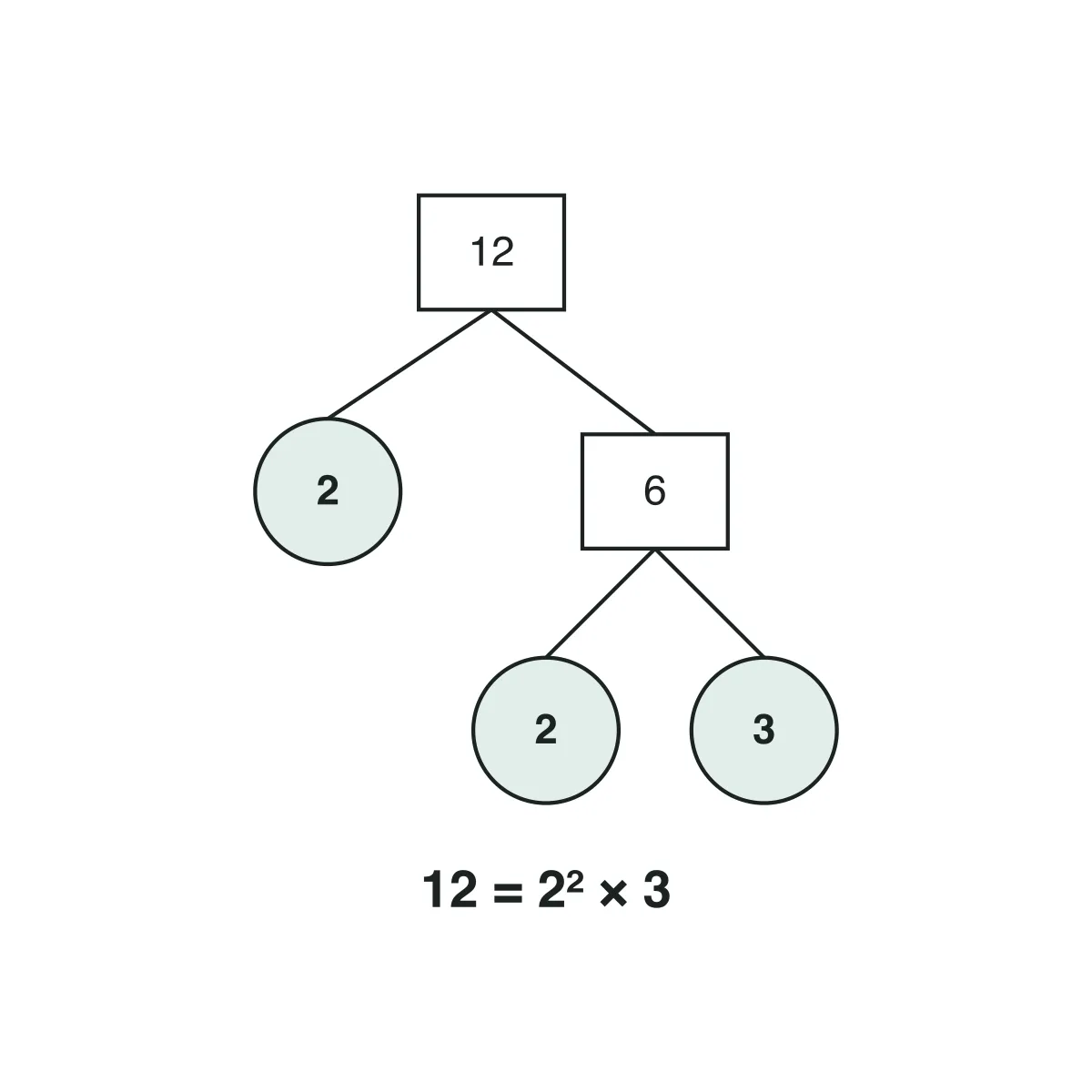
Here's how this factor tree generator does the splitting for you — type a whole number and it works out the smallest prime factor at every branch until nothing but primes are left.
Type any integer from 2 to 99,999 into the input above the preview. The generator checks it's a valid whole number in range before drawing anything, so you'll never end up staring at a broken tree.
Behind the scenes, the generator finds the smallest prime factor of your number, splits it off, and repeats on what's left — the same rule a teacher would use at the board, run automatically at every level.
Every branch stops at a circled prime; boxed numbers still had more splitting to do. Trace the tree top to bottom and the circles are your full prime factorization.
Toggle exponent form on to collapse repeated factors like 2 × 2 into 2², then download the finished tree as an SVG for editing or a PNG for a worksheet or slide.
Four factor trees this generator draws on request, each chosen to show a different shape a decomposition can take — from a single repeated prime to four factors that never repeat.
36 splits into 2 × 18, then 18 into 2 × 9, then 9 into 3 × 3 — two prime factors, each appearing twice, written as 2² × 3².
48 keeps splitting off 2s four times before landing on 3, giving 2⁴ × 3 — a good example of how lopsided a tree gets when one prime factor dominates.
60 factors into 2² × 3 × 5, mixing a repeated prime with two that appear only once — useful for comparing against 36 and 48 side by side.
210 is the product of four different primes — 2 × 3 × 5 × 7 — with no repeats at all, so every branch on this tree ends at a different circle.
Both methods land on the same prime factorization; they just organize the divisions differently. Pick whichever layout matches how your class — or your own habits — likes to track the work.
Branches outward from the starting number
Stacks repeated division by a prime, like an upside-down division bracket
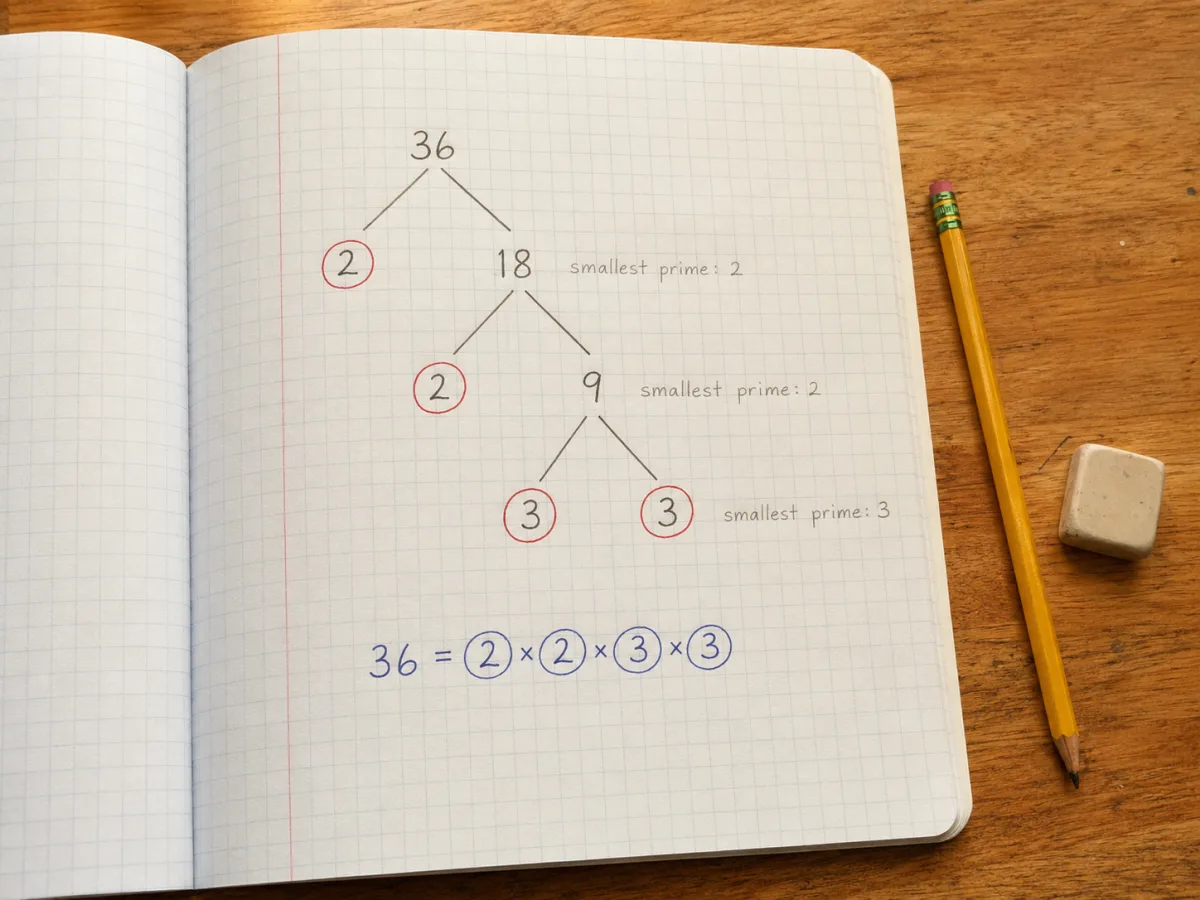
Working out which prime to split off next is the slow part of a factor tree by hand. This generator finds the smallest prime factor at every branch automatically, so a five-digit number gets the same instant tree as a two-digit one.
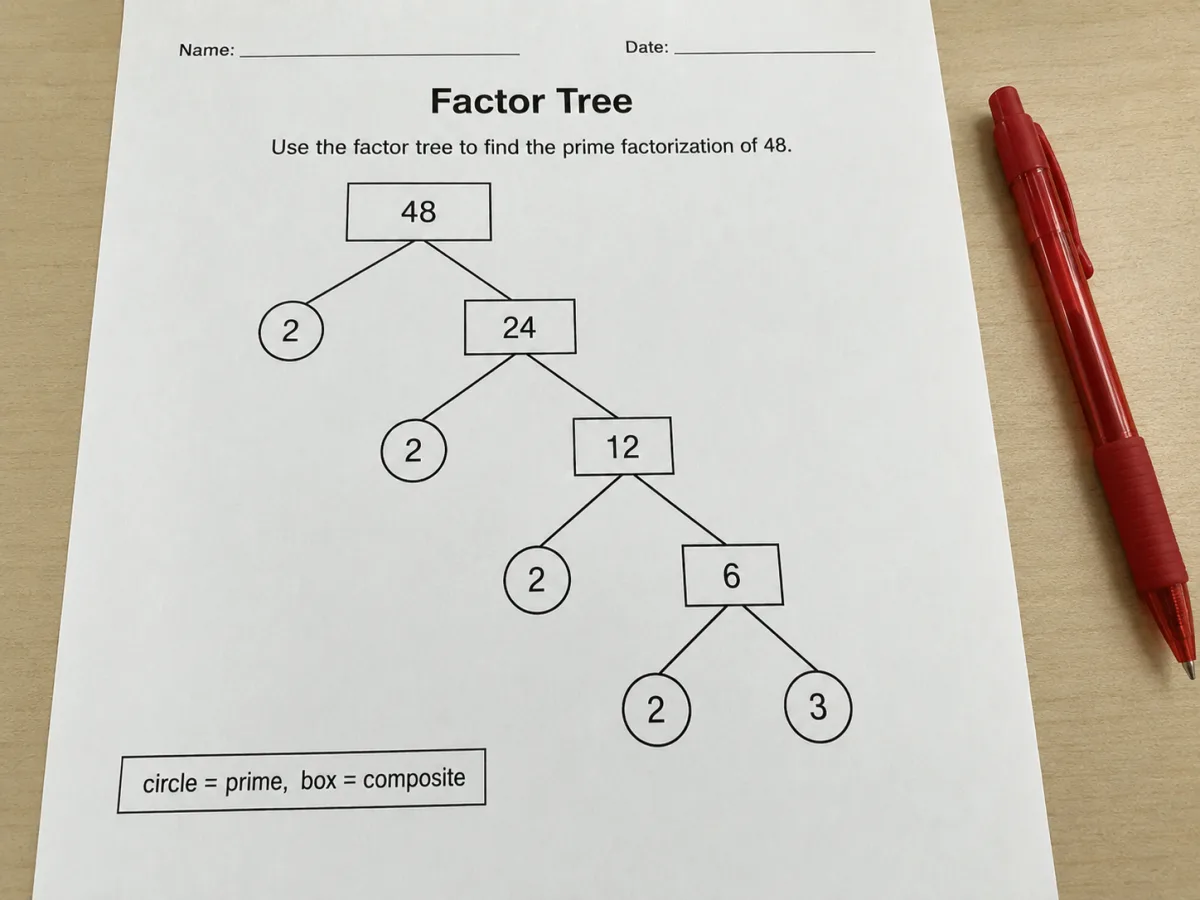
Every leaf that's prime gets a circle; every number that still needs splitting stays in a box. That shape difference makes a finished tree easy to grade or self-check at a glance, without reading each number to decide whether it's prime.
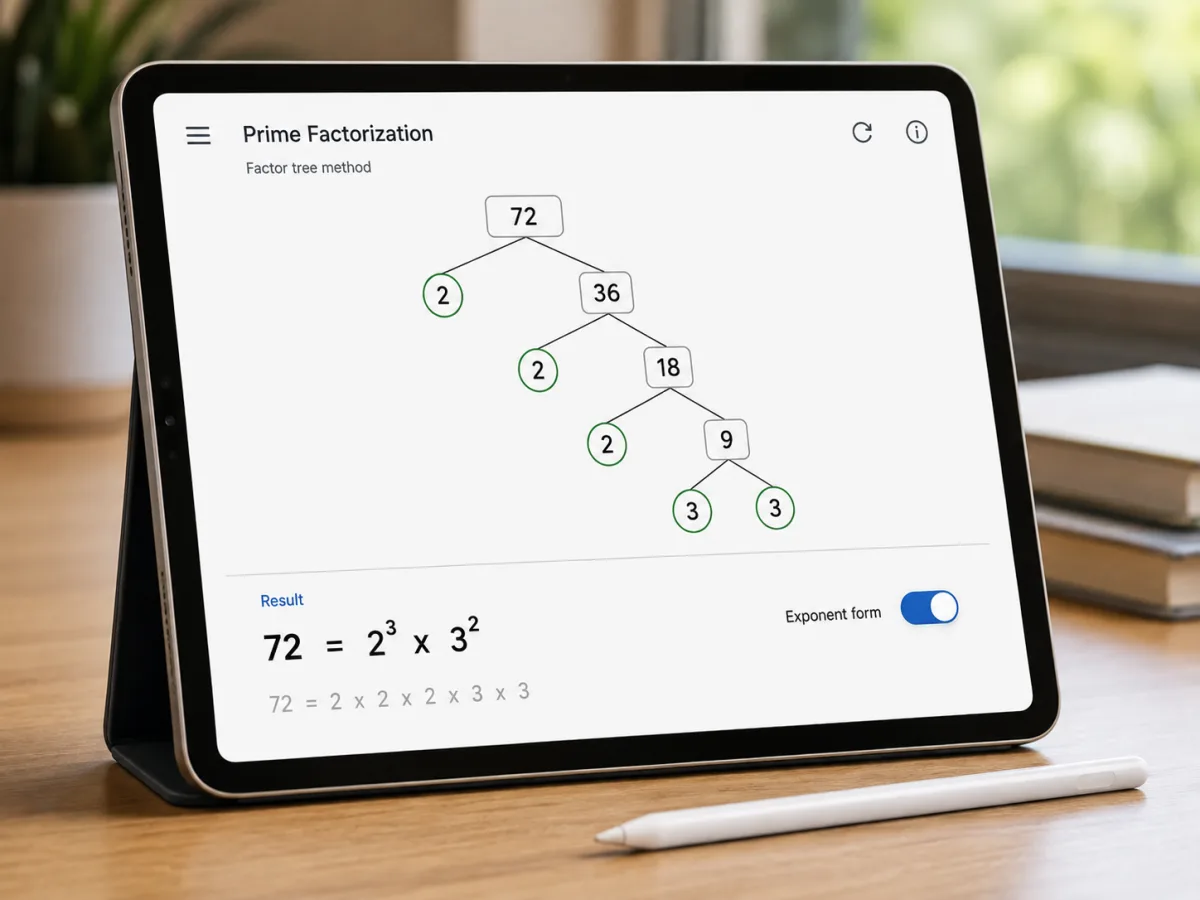
Flip a single switch to collapse repeated factors into exponent notation — 2 × 2 × 3 × 3 becomes 2² × 3² — or expand it back out for a class that hasn't covered exponents yet.
Straight answers to what students and teachers ask most about building a factor tree, checking one for uniqueness, and handling numbers a tree can't be built from.
Other generators on Figwise that pair well with a factor tree in a classroom or a study guide.


Type a number above and this factor tree generator finds every prime split for you — no scratch paper, no missed factors.