


 Figwise Team
The difference fits in two sentences. A theoretical framework is borrowed: an existing theory, taken from the literature, that explains why your prediction should hold. A conceptual framework is built: your own map of this study's variables and expected links, usually drawn as a diagram.
So "which is better" is the wrong question. The real question is which job your thesis needs done — and if you test links between variables, the honest answer is both. The theory supplies the reasoning. Your diagram turns it into boxes and arrows you can measure.
Most guides stop at side-by-side definitions. This one adds three things they skip:
- a two-question test for which framework your study needs,
- a worked example that runs from research question to finished diagram,
- the four mistakes committees flag most — each with a way to catch it in your own draft.
The difference at a glance
| Theoretical framework | Conceptual framework | |
|---|---|---|
| Where it comes from | An existing theory (or several), borrowed from the literature | You build it for this one study |
| How you arrive at it | Mostly deductive: theory predicts what you should find | Mostly inductive: theory + prior findings + your own logic, merged |
| What it contains | The theory's claims, its key concepts, why it fits your problem | Your study's variables and the expected links between them |
| Usual form | Written prose, sometimes with a visual | A diagram of boxes and arrows, plus a short narrative |
| Typical home | Quantitative, theory-testing studies | Any study that maps variables; common in mixed and applied work |
One caution before the table hardens into a rule. The two are not rivals, and "theoretical means quantitative, conceptual means qualitative" is a tendency, not a law.
Which one is broader is contested too. This article uses the narrow, common sense of a conceptual framework: the variable map for one study.
A second convention runs the other way. The Kivunja definition on the Kean page quoted below treats the conceptual framework as the whole-project orientation, with the theoretical framework sitting inside it. If your department works that way, keep the labels and ignore the nesting.
In practice, one feeds the other. The theory tells you which variables matter. Your diagram shows how you expect them to connect in your setting.
What is a theoretical framework?
A theoretical framework is the established theory your study stands on, plus your case for why it fits. The USC Libraries research guide states the structural role plainly.
"The theoretical framework is the structure that can hold or support a theory of a research study."
Note what that covers: not just naming a theory, but arguing for it. Kivunja's definition, quoted in Kean University's research guide, shows the working part.
"A theoretical framework comprises the theories expressed by experts in the field into which you plan to research, which you draw upon to provide a theoretical coat hanger for your data analysis and interpretation of results" (Kivunja, 2018, p.45).
The "coat hanger" image is the useful bit. The theory is where your findings will hang. Study workplace motivation through Self-Determination Theory, and its three needs become the terms you collect data on. A different theory gives you different terms — and a different study.
Two practical tests follow.
- It must be named and cited. A theoretical framework is somebody's published theory. If your framework section cites no theorist, it is not a theoretical framework yet.
- It must do work later. Delete the section. If nothing in your methods or discussion breaks, the theory was decoration. USC's guide warns against exactly this: theory that appears once in the introduction and never again.
What is a conceptual framework?
A conceptual framework is your own model of the study: which factors you will examine, and how you think they relate. The standard definition is from a classic methods text. The University of Melbourne's doctoral guide quotes it.
"A conceptual framework explains, either graphically or in narrative form, the main things to be studied - the key factors, constructs or variables - and the presumed relationships among them. Frameworks can be rudimentary or elaborate, theory-driven or commonsensical, descriptive or causal." (Miles & Huberman, 1994, p.18)
Three words in that definition carry the contrast.
- "Presumed." The links are your informed bets, stated before the data comes in. Each arrow is a claim you will test — which is why many students write hypothesis labels (H1, H2) right on the arrows.
- "Constructs or variables." The framework lists what this study measures or observes — not every idea the literature mentions.
- "Graphically." Miles and Huberman allow narrative form too. The figure is the version a committee can interrogate, though: if you cannot draw it, you have not yet decided what relates to what.
Where does the content come from? Rarely from one theory alone. You pull one link from a theory, another from prior findings, a third from your own field knowledge.
Then you weld them into one model. That merge — many sources, one map for your study — is what makes it "conceptual" rather than "theoretical."
Which one does your thesis need?
Two questions settle it for most studies. Answer both, in order.
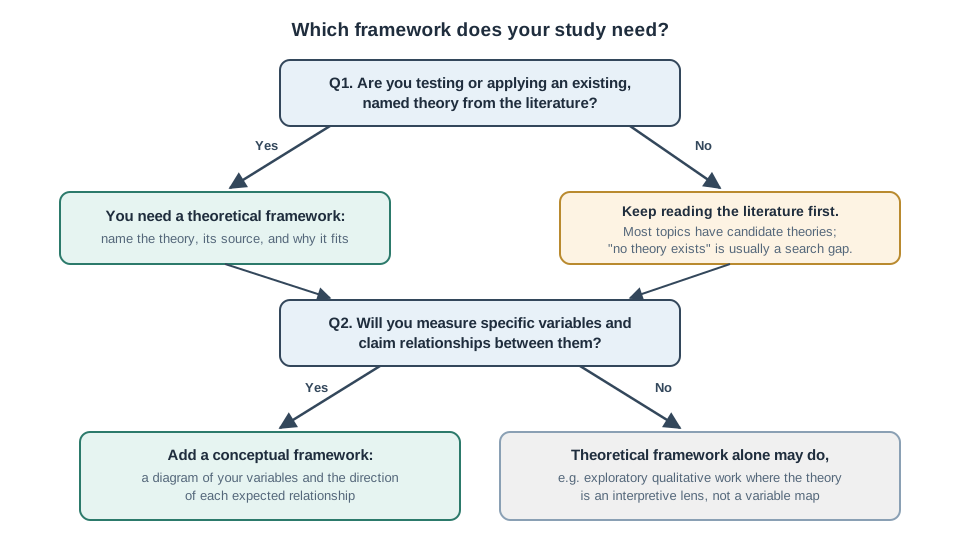
Two questions that decide which framework your study needs. Diagram drawn by the FigWise team for this article.
Q1: Are you testing or applying an existing, named theory? If yes, you need a theoretical framework section: name the theory, cite its source, and argue why it fits better than the alternatives. If you think no relevant theory exists, treat that as a warning sign. Almost any topic old enough for a thesis has theories on offer, so "none exists" usually means the search is not done.
Q2: Will you measure specific variables and claim links between them? If yes, add a conceptual framework. Any study with hypotheses, or with an "X affects Y" question, belongs here — that is why most theses that test theory carry both. If no, the theory can serve as a lens on its own, and a study of how nurses experience night-shift work may need no variable map at all.
| Q1 theory? | Q2 variables? | What your thesis needs |
|---|---|---|
| Yes | Yes | Both: theory section, then your own variable map |
| Yes | No | Theoretical framework alone, used as a lens |
| No | Yes | Conceptual framework, built from several sources |
| No | No | Go back to the literature before writing either |
Tip: before you commit, read two or three accepted theses from your own department. Naming habits differ across fields and even across advisors — some programs fold both into one "Framework" section, others demand two. The concepts stay the same; the labels move.
How to build a conceptual framework: a worked example
The whole build is four steps. State the question, pull variables from the literature, commit to a direction for every link, then draw it. Here is each step on one running example.
The study below is fictional. We invented it for this walkthrough; it does not cite real research. But the moves are the ones you will repeat on your real topic.
The research question: Does more frequent instructor feedback improve graduate students' academic writing quality?
Step 1: Fix the question before the framework
A framework can only be as sharp as the question. "Does feedback help writing?" cannot be built. "Help" is not measurable, and "feedback" is not one thing. The version above works because each noun can become a variable: feedback frequency (countable), writing quality (scorable with a rubric).
Step 2: Pull the variables from the literature
Read the prior studies on your question. List the factors they found to matter. Then sort the list into roles.
- Independent variable — the cause you vary or compare: feedback frequency.
- Dependent variable — the outcome you measure: writing quality score.
- Mediating variable — the mechanism in between. Feedback cannot improve a text by itself; students must act on it. So: revision behavior, the main route through which frequency reaches quality. H4 below keeps a direct path as well, which makes this partial mediation, not full.
- Moderating variable — a condition that changes the strength of a link. In a large class, each round of feedback tends to get shallower. So class size may weaken the frequency-to-revision link.
- Control variable — a known influence you adjust for statistically, so it cannot pose as your effect: prior writing score.
The discipline here is exclusion. Motivation, native language, and advisor style all plausibly matter — and they stay out, because this study will not measure them. Treat the diagram as a contract in one direction: everything in it gets measured. The reverse does not hold — you will measure covariates, checks and demographics that never earn a box.
Step 3: Commit to a direction for every link
Now turn the list into claims. Each arrow needs a direction and, ideally, an expected sign.
- H1: More frequent feedback increases revision activity (+).
- H2: More revision activity increases writing quality (+).
- H3: Class size weakens the H1 link (moderation).
- H4: Frequency also has a direct effect on quality, expected weaker than the mediated path.
If you cannot decide which way an arrow points, that is not a drawing problem. It means the literature review has not yet answered a question your study depends on. Go back one step.
Step 4: Draw it
Use boxes for variables and solid arrows for your main claimed effects. Give moderators, controls and secondary paths a distinct look. In the figure below, H4 is a claimed effect too, drawn dashed because it is the weaker direct route.
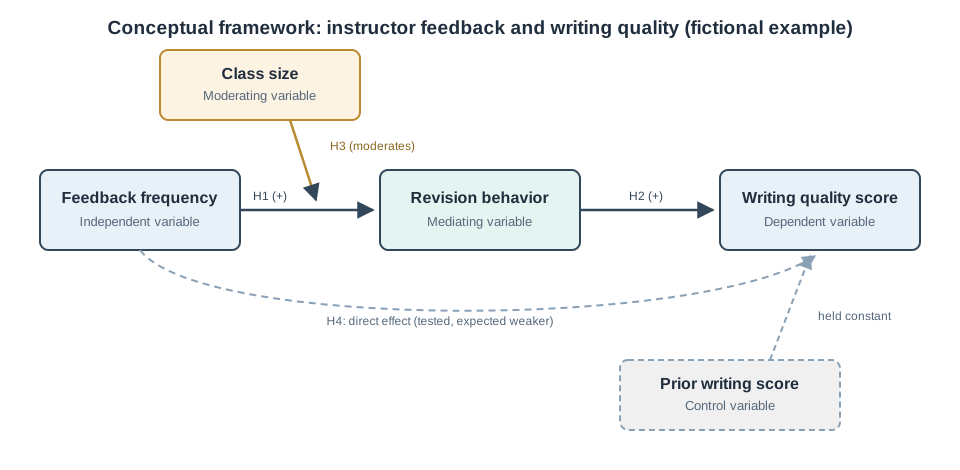
The finished framework for the fictional feedback study. Drawn by the FigWise team for this article; hypothesis labels sit on the arrows they claim.
For the drawing itself, any tool works: PowerPoint, draw.io, or plain SVG. Want a fast first draft to react to? Our conceptual framework generator turns a few sentences about your study into a framework diagram as a PNG image.
It is an AI image tool, so treat the output as a starting sketch. Check every box label and arrow against your variable list, and redraw the final version yourself for submission. If an AI-drawn figure does stay in a manuscript, you may need to disclose it. Our guide to AI-generated figures and journal policies covers which publishers allow what.
Later, the settled framework often becomes the skeleton of your paper's summary figure. A graphical abstract maker can reuse the same boxes-and-arrows logic at that stage.
Where each framework goes in your thesis
Both frameworks live in the front half of the document. The standard pattern: announce early, develop in the literature review. Kean University's guide says where each one goes.
"The discussion of your framework is addressed in your Chapter 1, the introduction and then is further explored through in-depth discussion in your Chapter 2 literature review."
In the classic five-chapter thesis, that means a short framework statement in Chapter 1. The full argument comes in Chapter 2.
USC's guide places the theoretical framework right after the research problem, inside the introduction. It adds a timing warning worth quoting.
"[A] complete theoretical framework will likely not emerge until after you have completed a thorough review of the literature."
In other words: the section appears early, but you write it late. Draft the literature review first, then distill the framework from it.
The conceptual framework diagram most often lands at the end of the literature review chapter. There it acts as the chapter's close. It says: here is what the literature adds up to, in one figure — and here is the model my methods will test.
Some departments put it at the start of the methods chapter instead. Either way it sits at the hinge between reviewing and testing. It is typically short: the figure, plus one narrative paragraph per link.
Four mistakes committees flag — and how to catch each one
1. A literature summary wearing a framework's name tag
The section retells what ten studies found, predicts nothing, and ends. The catch: find the sentence in your framework section that makes a claim your study will test. If every sentence reports what others found, and none commits you to an expectation, you have written literature review — not framework.
2. Variables in the diagram that the study never measures
"Motivation" sits in a box because leaving it out felt wrong — but no instrument in the methods chapter measures motivation. The catch: for every box, point to the exact instrument, dataset column, or interview question that captures it. A box you cannot point from is either a variable to start measuring or a box to delete.
3. Arrows without direction — or with directions nobody chose
Lines connect the boxes, but some have no arrowhead, and one points a way the text never argues for. The catch: read each arrow aloud as a sentence. "I expect [box A] to raise or lower [box B], because [source]." No direction, or no because? Then the arrow is decoration — and a committee member will ask about exactly that one.
4. A borrowed theory relabeled as a conceptual framework
The "conceptual framework" turns out to be the Technology Acceptance Model's own diagram, redrawn with the same boxes and the same arrows. That is a theoretical framework — a fine one — just mislabeled.
The catch: count what you changed. A real conceptual framework adapts the theory to your study: a variable added from other sources, one dropped, or a link changed. If the diff against the original theory is zero, call it what it is.
FAQ
Can a thesis have both a theoretical and a conceptual framework?
Yes — and theory-testing theses usually should. They do different jobs in sequence: one justifies why your predicted links should exist, the other names which variables and links your study tests. The common pattern is theory feeding diagram — some of your arrows exist because the theory predicts them.
Is a conceptual framework only for quantitative research?
No. The variables-and-hypotheses style of diagram fits quantitative work best, but qualitative studies use conceptual frameworks too. There they map guiding concepts and suspected connections rather than measured variables. Miles and Huberman, the source of the standard definition, wrote it in a qualitative methods textbook.
Can I change my conceptual framework after data collection starts?
Often yes — but document it. In qualitative and mixed designs, revising the framework as you learn is normal practice. The final thesis then shows the revised model and explains what changed and why.
In strict theory-testing work, changing hypotheses after seeing the data is a red flag. New links you notice belong in "future research," not in a quietly edited diagram.
How many variables should a conceptual framework have?
As few as answer the research question. Most workable master's frameworks hold three to six main parts; the fictional example above uses five, counting the moderator and the control.
Past that, each added box multiplies the links you must justify, measure, and test. A 12-box framework is usually three studies wearing one diagram.