

 Figwise Team
Ask whether you can put an AI-made figure in a paper and you get two opposite answers. Some guides say every big publisher accepts them if you disclose in your Methods. Others say images are banned almost everywhere.
Both are wrong. Acting on either one can cost you a round of revisions.
Two things decide your case: the publisher you submit to, and the kind of figure you made. A PRISMA flow chart and a western blot are not the same object, even under one policy. Below are six publishers, quoted from their own pages, plus the part most guides get wrong — where the disclosure goes.
The figure type decides more than the tool
Publishers sort figures into three buckets, and the AI rules differ for each.
- Explanatory figures — flow charts, decision trees, timelines, schematics, workflow diagrams. The loosest bucket.
- Research and data images — plots drawn from your data, plus raw images such as microscopy, histology, blots and scans. No publisher lets AI make or alter the raw ones.
- Graphical abstracts and cover art — visual summaries of the paper. These have their own rules, and they are stricter than most authors expect.
Elsevier's policy for journals says this outright:
"Images generally fall into three categories, and the permitted use of AI tools differs for each."
Other publishers skip the labels. Their rules split the same way.
So "can I use AI for figures?" has no answer. "Can I use AI for a workflow diagram in an Elsevier journal?" does.
What each publisher says
Elsevier
Elsevier is the loosest of the six, and the clearest. Its generative AI policy for journals even names the figures you may use AI for:
"Authors may use AI tools to support the creation of certain types of explanatory images for publication, such as flow charts, decision trees, timelines, schematic conceptual illustrations, or experimental workflow diagrams."
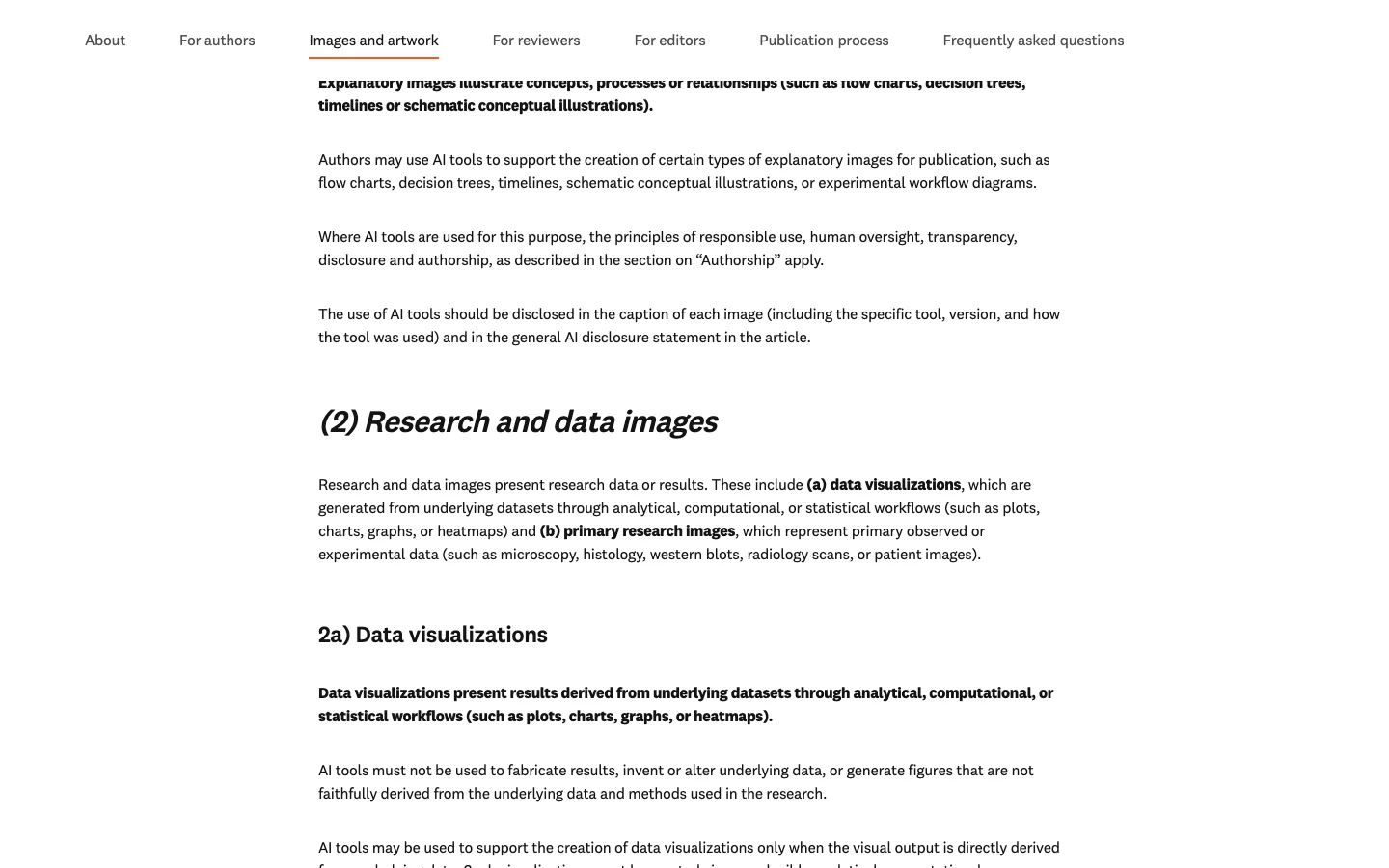
Elsevier's "Images and artwork" policy, section (1) Explanatory images. Source: elsevier.com, captured 22 August 2026.
Two limits sit on the other side:
"AI tools must not be used to create or alter images that represent primary observed or experimental data."
Data plots are allowed only when the picture comes straight from real data.
Springer Nature
Springer Nature does not allow them. Its AI guidance for researchers is blunt:
"Avoid generative AI images or figures. These are not permitted for publication unless they meet specific exceptions."
Those exceptions are narrow. Each one must carry the label "AI-generated."
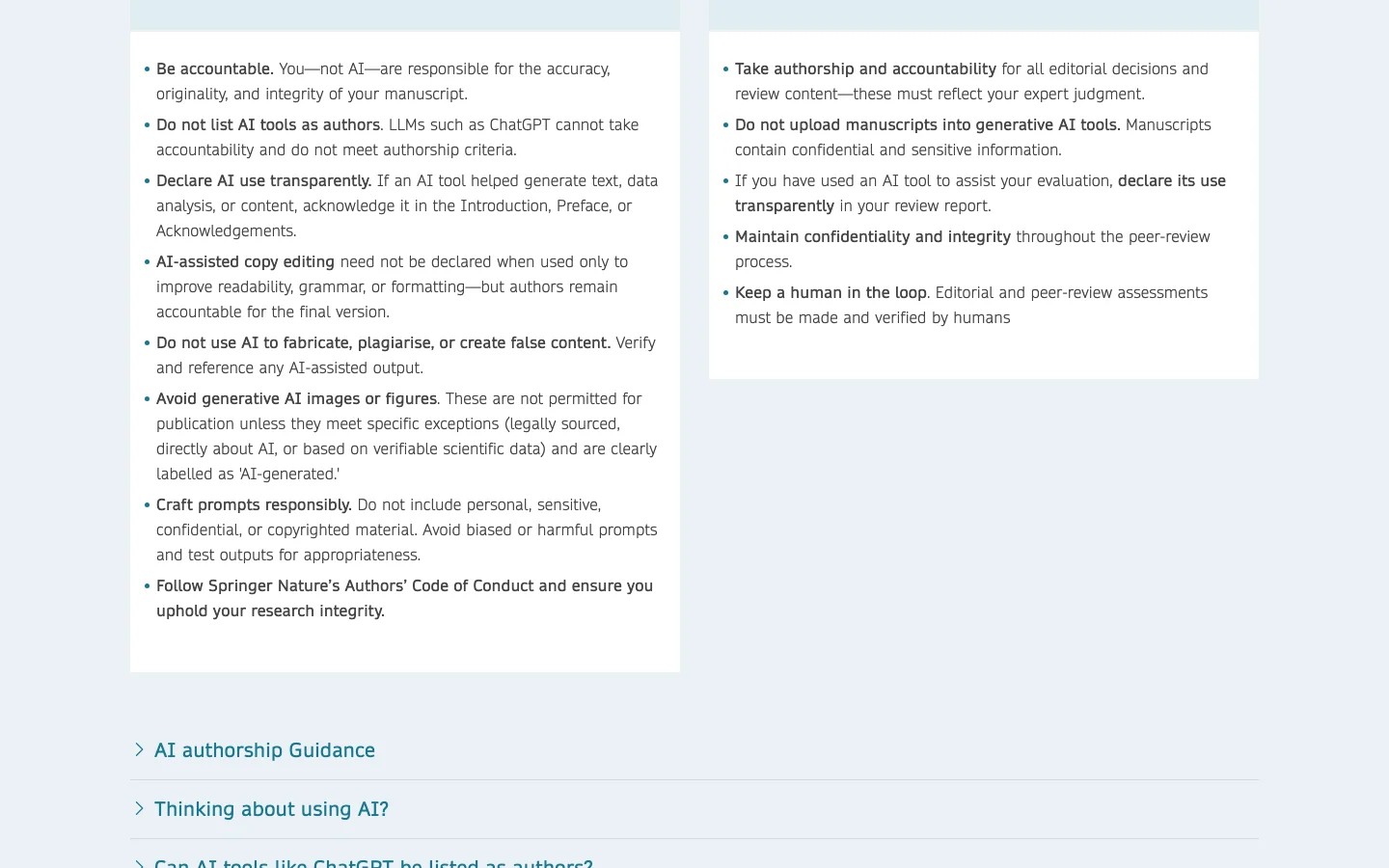
Springer Nature's AI guidance for researchers, author checklist. Source: group.springernature.com, captured 22 August 2026.
Here is the flat contradiction behind all the confusion. A guide that says Nature journals accept AI-made figures is quoting Elsevier's rule, not this one.
Science (AAAS)
Science makes you ask first:
"AI-generated images and other multimedia are not permitted in the Science journals without explicit permission."
Papers about AI itself can get an exception, case by case.
The science.org policy page blocks bots, so this wording comes from the Cold Spring Harbor Laboratory library guide, which quotes the policy. Check the live page before you lean on it.
Cell Press
Cell Press is the strictest of the six:
"We do not permit the use of Generative AI or AI-assisted tools to create or alter images in submitted manuscripts."
The one exception is AI that is part of the research method. This quote comes from the same library guide, for the same reason; the binding version sits in each journal's information for authors.
Cell Press is an Elsevier imprint with a tighter rule than its parent. Imprint rules win, so read the journal's own author guide.
PLOS
PLOS has no image rule for AI. Its ethical publishing practice policy covers you instead:
AI contributions "must be clearly reported in a dedicated section of the Methods."
Its older image rule still holds. Images must not be changed in ways that could mislead, whether by AI or by hand.
Wiley
Wiley allows it, with the editor in charge. Its ethics guidelines say AI tools have a place in figure work:
AI "may be used for creating data visualizations and illustrations."
Photo touch-ups face limits. And Wiley keeps the final call: the decision "belongs to the journal's editor."
The matrix
Each cell is that publisher's stance on that figure type, as of 22 August 2026.
| Publisher | Explanatory diagrams | Data plots | Raw data images | Graphical abstracts |
|---|---|---|---|---|
| Elsevier | Allowed, disclose in caption | Allowed if drawn from real data | Not allowed | No general-purpose AI image tools |
| Springer Nature | Not permitted, narrow exceptions | Not permitted, narrow exceptions | Not permitted | Not permitted |
| Science (AAAS) | Ask the editor | Ask the editor | Not permitted | Ask the editor |
| Cell Press | Not permitted | Not permitted | Not permitted | Not permitted |
| PLOS | No clause, disclose in Methods | No clause, disclose in Methods | Image rules apply | No clause |
| Wiley | Allowed, editor decides | Allowed, editor decides | Limited | Allowed, editor decides |
One pattern runs through all six. No publisher lets AI near an image that stands in for observed data. The fight is only about diagrams and summaries.
The gaps between the rows are not an artifact of how I read them. A 2026 review of publisher policies on arXiv reports the same inconsistency across these publishers, and calls the fragmented landscape a practical problem for authors submitting to more than one venue.
Graphical abstracts are the trap
The bucket authors most want AI for holds the surprise:
"General-purpose generative AI image tools must not be used to create graphical abstracts."
Elsevier's reason is craft, not ethics. A graphical abstract packs many icons and design parts into one image. So the rule steers you to a class of tool rather than banning the job:
"Authors are encouraged to use dedicated scientific illustration tools when preparing graphical abstracts."
Such tools, it adds, "offer well-defined licensing terms."
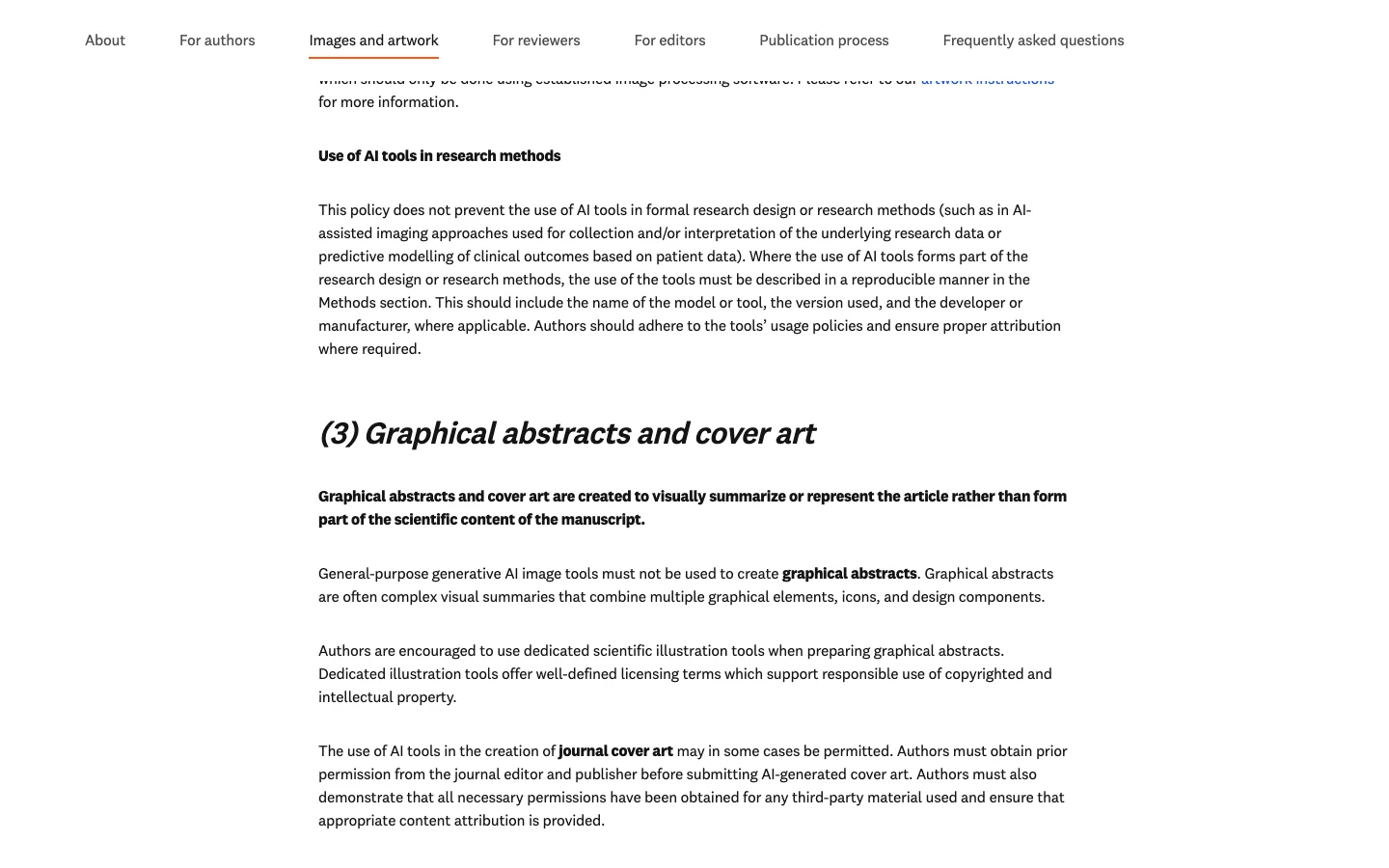
Elsevier's rule on graphical abstracts and cover art. Source: elsevier.com, captured 22 August 2026.
That rules out typing a prompt into a general image model. Elsevier names what it wants instead:
"Authors should use dedicated scientific illustration tools (such as BioRender or Mind the Graph) or other professional illustration tools when preparing graphical abstracts."
Its summary table adds one duty whichever tool you pick: "Mention the tool used in the image caption."
Be clear about where an AI tool sits in that split, including ours. The graphical abstract maker on this site sends your abstract to a general image model and returns a flat PNG, so it falls on the side Elsevier rules out for a submitted graphical abstract. Draft a layout with it if that helps, then rebuild the file you submit in an illustration tool.
Cover art has its own rule at Elsevier. Get permission from the editor and publisher before you submit it.
Where the disclosure goes is not always Methods
This is the error I see most in other guides. It is also the one most likely to draw a query from the editors. "Disclose in your Methods" is right for one of these six.
| Publisher | Where the disclosure belongs |
|---|---|
| Elsevier, explanatory images | The caption of each image, plus the article's general AI statement |
| Elsevier, data plots | Methods, with tool name, version and developer |
| Springer Nature | Label the image "AI-generated"; declare AI use in the Introduction, Preface or Acknowledgements |
| Cell Press | The figure legend |
| PLOS | A dedicated section of the Methods, or the Acknowledgements |
| Wiley | State it clearly; the editor decides what is enough |
Two sentences you can adapt.
In a caption: "Figure 1 was prepared with [tool name, version]. The authors designed the figure, checked every label against the source data, and take full responsibility for it."
In a Methods or AI statement: "During the preparation of this manuscript the authors used [tool name, version] from [developer] to draw the workflow diagram in Figure 1. The authors reviewed and edited the output and take full responsibility for the content of the publication."
Four mistakes that draw a query
- Treating a data plot as a diagram. A chart built from your dataset must come from a real analysis you can repeat, not from a model asked to draw something plausible.
- Using a general image model for a graphical abstract. Barred at Elsevier, however good the picture looks.
- Disclosing in one place only. Elsevier wants the caption and the article-level statement. One without the other is half done.
- Reading the publisher and stopping. Cell Press is stricter than Elsevier, and single journals add terms. The journal's author guide is the version that binds you.
Keep your prompts and drafts, too. Elsevier warns that authors "may be asked to provide documentation of their AI use and the original, unprocessed images."
FAQ
Does a PRISMA or CONSORT flow diagram count as an explanatory figure?
Yes, under Elsevier's wording. Flow charts and workflow diagrams are both on the permitted list.
A PRISMA flow diagram or CONSORT diagram is a flow chart whose numbers come from your own screening or enrolment records. Name the tool in the caption, and check the numbers yourself. The policy makes accuracy your job, not the tool's.
Who owns an AI-made figure?
Nobody can give you a settled answer, and the policies show it. Springer Nature builds its exceptions around images that are legally sourced or traceable. That is a licensing test, not a copyright ruling. It is also why publishers point to tools with clear terms for their assets.
Do preprints need the same disclosure?
The library guide that tracks these rules lists bioRxiv and medRxiv among the servers with no image-specific policy. Use your target journal as the standard anyway. The preprint figure is usually the one you end up submitting.
Is a schematic safer than a lifelike image?
Yes, at every publisher here. All six split diagrams from anything that could pass for observed data. Lifelike cells, tissue or lab gear are the riskiest thing you can submit. A labelled schematic is the safest.
Before you submit
Do three things. Read your target journal's author guide, not just the publisher's page. Put the tool name and version in the caption, and repeat it wherever that publisher wants the article-level statement. Keep the prompts and the raw files until the paper is out.
All six publishers have rewritten these rules at least once since 2023. Check the live page rather than a summary — including this one. Every quote above links to its source: Elsevier, Springer Nature, Science, Cell Press, PLOS, Wiley.